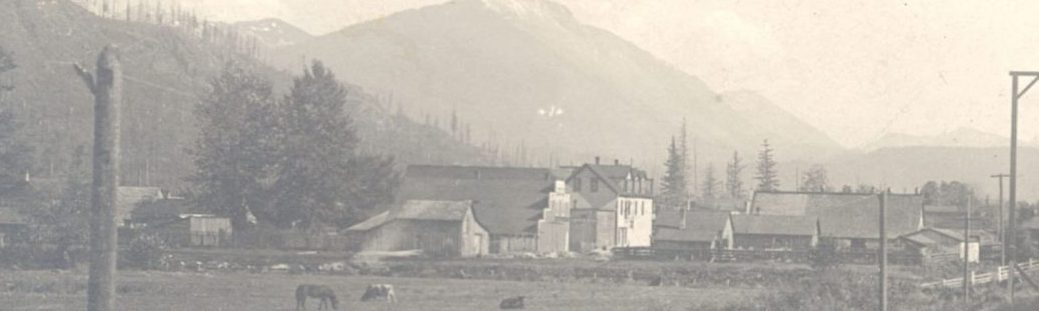


Lucinda Collins Fares Gordon (c. 1830s–1880s)
Lucinda Collins is remembered as one of the earliest non-Native women to settle in the Snoqualmie Valley. She and her husband, Joseph Fares, homesteaded what became known as the Toll Gate Farm at the western entrance to present-day North Bend. In local histories, she is often described as the first Euro-American woman to reside in the Snoqualmie Valley.
Lucinda was the daughter of Luther and Diana Collins, early settlers in the Puget Sound region. Her uncle was J.W. Borst, another prominent early settler. Her father, Luther M. Collins, initially settled in the Nisqually Valley before relocating in 1851 to Elliott Bay at the encouragement of fellow pioneers including Henry Van Asselt and Jacob Maple. The Collins family moved to the Duwamish River shortly before the arrival of the Denny Party at Alki Point. Today, areas such as Georgetown and Boeing Field occupy land that once comprised these early claims.
Lucinda and Joseph Fares first lived in the old Kellogg cabin alongside Robert Smallman, on land just north of what became the Toll Gate Farm. They later constructed their own home near the same location. Their barn incorporated an older log structure known as Fort Smalley, which stood west and slightly north of the later barn.
Known locally as “Lucindy,” she became a memorable figure in valley lore. She was described as physically large and warmly hospitable. Her home served as a welcome stopping place for travelers crossing Snoqualmie Pass, and many recalled her generosity toward those making the difficult journey through the mountains.
At one point, Lucinda adopted a young boy who had been left behind by parents traveling through the region. Although she did not receive formal schooling and could not read or write, she was fluent in the language spoken by the local Native people, having grown up among Native communities along the Duwamish River. Her familiarity with their language and cultural traditions reflected the close proximity in which early settler and Native families often lived.
One frequently retold story from her youth illustrates this cultural knowledge. After a settler shot two dogs belonging to Native residents, tensions rose. Lucinda, then a teenager, understood the seriousness of the situation and went to speak with members of the Native camp. Drawing on their spiritual beliefs—specifically that a person who already carried lead in their body could not be harmed by more—she warned them that the shooter was protected and highly skilled with a gun. Her intervention, combined with a public display of marksmanship by the settler, is said to have helped prevent further violence. While such stories reflect the perspectives of early settler narrators and must be read critically today, they underscore Lucinda’s role as a cultural intermediary during a volatile period.
Many local anecdotes also centered on her dairy work. Because mobility was difficult for her, she reportedly sat on her milking stool and called each cow by name, and they would approach in turn. Stories about her butter circulated widely in valley folklore—some affectionate, others humorous or critical. Accounts from neighbors suggest that dairy sanitation practices common in the mid-19th century did not always meet modern standards. These recollections, though often exaggerated for effect, became part of the oral tradition surrounding her life and personality.
Joseph Fares was born February 11, 1836, in Middlesex County, Ontario, and was said to have worked for the Hudson’s Bay Company before coming to the Snoqualmie Valley. He and Lucinda married in the late 1850s. By the late 1860s they had separated, and Joseph eventually left the region, later dying in Park City, Utah.
Lucinda later married John Gordon and remained in the Snoqualmie Valley until the early 1880s. After the death of her brother Steve, she returned to the family homestead along the Duwamish River to manage family affairs. Contemporary accounts describe her departure from Snoqualmie Prairie as deeply emotional.
She died following complications from an infection that began with a splinter injury to her toe. Despite multiple amputations, her life could not be saved. She was initially buried in Seattle’s Denny Hill cemetery. When Denny Hill was regraded in the early 20th century, remains from the cemetery were relocated to Lake View Cemetery near Volunteer Park. Later retellings claimed that her remains were unusually well preserved at the time of reinterment—another detail that contributed to the larger-than-life folklore that surrounded her memory.
Today, Lucinda Collins Fares Gordon is remembered as a resilient early settler whose life reflects both the hardships and complexities of the mid-19th-century Pacific Northwest.